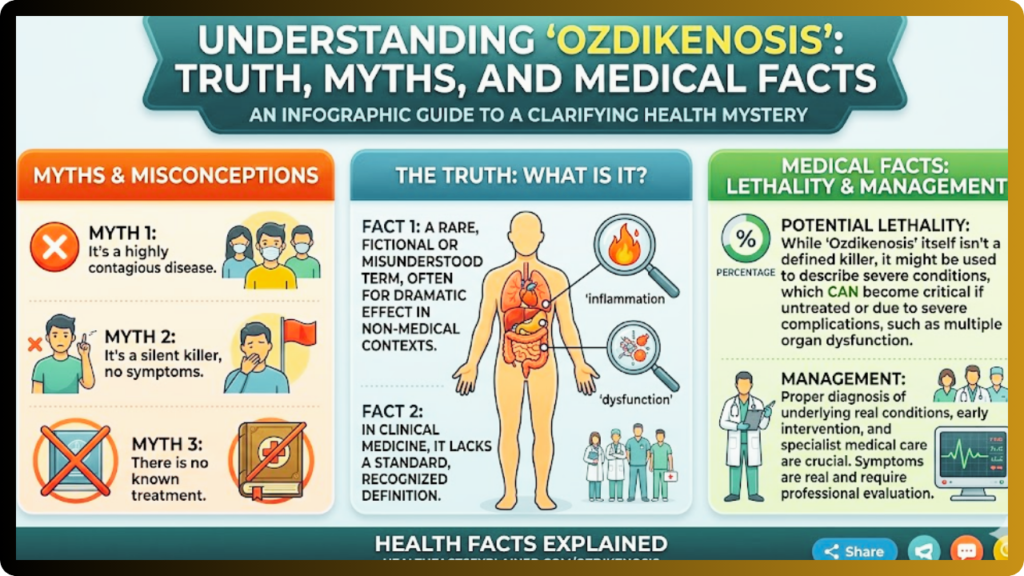

The search for why does ozdikenosis kill you has become popular online, even though the term itself does not exist in medical science. Many people see it mentioned in forums or social media and assume it is a real disease. This creates confusion and raises unnecessary fear among readers. In reality, there is no verified medical condition known as ozdikenosis. Understanding this topic requires separating online myths from real scientific facts. This article explains the truth behind the term and why it is not medically recognized. Many users search it due to curiosity rather than medical concern. The term often spreads without any scientific background. It is important to verify health-related information before believing it. Online platforms can sometimes exaggerate unknown words. This increases misunderstanding among readers. Awareness is the first step toward clarity. People often misunderstand viral terms as real diseases. Search engines increase curiosity about such keywords. Lack of medical verification creates confusion. Readers should always cross-check facts. Misleading content can appear very realistic. Proper awareness prevents misinformation spread. People should not assume every medical-sounding word is real. Online curiosity often increases search trends. Verification is essential for accurate understanding. Digital awareness helps users avoid unnecessary fear and confusion.
Who Is Ozdikenosis
Ozdikenosis is not a real person, disease, or medically defined condition, which is why the question why does ozdikenosis kill you is based on misinformation. The term appears to have no origin in scientific literature or healthcare systems. It is most likely a fictional or fabricated word that gained attention online. Because of this, there are no clinical records or medical descriptions linked to it. This makes it impossible to classify or study as a real condition. Any claims about its effects are based purely on speculation. There is no historical or medical reference supporting its existence. It does not appear in any hospital records or research papers. Experts confirm it is not part of known diseases. The term is likely generated through online storytelling. People often misunderstand such fabricated words. This leads to unnecessary curiosity and confusion. No biological classification exists for it. No scientific institution recognizes it. It has no diagnostic criteria. Medical professionals do not acknowledge it. It cannot be treated or analyzed. It remains entirely fictional. It has no biological mechanism. It exists only as an internet concept. There is no scientific validation. It has no clinical significance in medicine.
Why Does Ozdikenosis Kill You
Lack of Medical Existence
The main reason behind why does ozdikenosis kill you is confusion, as the condition does not exist in medical science. Without biological evidence, there is no explanation for how it could affect the human body. Doctors and researchers do not recognize it as a disease. This means there are no studies, treatments, or recorded cases. As a result, claims about its fatal nature are not supported by any scientific data. It remains a term without medical definition. There is no pathology linked to it in any system. No symptoms have been clinically verified. Medical experts classify it as non-existent. It cannot be diagnosed or tested. It has no biological mechanism. Therefore, it holds no medical relevance. No laboratory findings support it. No patient history includes it. It is absent from medical textbooks. Scientists do not study it. It has no real-world application. It is purely fictional terminology. No healthcare system recognizes it. It cannot cause biological harm. It has no scientific basis for disease classification.
Misleading Information and Online Spread
How Misinformation Creates Fear
The question why does ozdikenosis kill you often spreads due to misleading online content and social media posts. When people see unfamiliar medical-sounding terms, they may assume they are serious conditions. This leads to rapid sharing without verification. Over time, repeated exposure makes false information appear believable. Such misinformation can create unnecessary panic and confusion. It highlights the importance of checking facts before accepting online claims. Digital platforms amplify unverified content quickly. Users often share without reading full context. Algorithms push trending topics even if they are false. This increases visibility of incorrect information. Many people believe it due to repetition. Critical thinking helps reduce this spread. False health claims can go viral easily. Emotional reactions increase sharing speed. Fact-checking is often ignored. Awareness helps stop misinformation cycles. Even harmless-looking terms can mislead large audiences. Social media accelerates rumor spread. Misinterpretation increases fear levels. Digital awareness is essential for safety. Online responsibility is important for users.
Real Understanding of Health Risks
Difference Between Fiction and Real Diseases
In reality, why does ozdikenosis kill you has no scientific answer because it is not a real illness. Genuine diseases have clear causes, symptoms, and medical explanations supported by research. Conditions like infections, heart disease, or respiratory disorders are properly studied and documented. Unlike fictional terms, they can be diagnosed and treated by healthcare professionals. Understanding this difference helps people avoid confusion and focus on real health concerns. Accurate knowledge is essential for proper awareness. Real diseases are backed by clinical trials. They have measurable symptoms and treatments. Doctors rely on evidence-based medicine. Fictional terms lack any such foundation. This makes them medically irrelevant. Awareness helps distinguish truth from myth. Real conditions also have diagnostic tests. Hospitals maintain patient records. Treatments are scientifically tested. Research supports real disease understanding. Medical science evolves through evidence. Fiction cannot replace real diagnosis. Real diseases have biological mechanisms. Fictional terms do not.
Scientific Reality Behind the Term
No Medical Evidence or Records
There is no scientific database or medical journal that recognizes ozdikenosis. The keyword why does ozdikenosis kill you often trends because people assume it is a hidden or rare disease. However, researchers confirm that no such condition exists in pathology or biology. Without evidence, it cannot be classified or analyzed medically. This makes it purely a fictional or internet-created term. It has no impact on human health in reality. No lab results support its existence. No case studies have ever been recorded. Medical classifications exclude it completely. Scientists do not study it because it is not real. It remains outside all medical frameworks. Therefore, it has no clinical value. It does not appear in WHO records. It is absent from global disease lists. No expert reviews mention it. It cannot be medically verified. It has no scientific credibility. It is entirely non-existent. It has no biological effect. It is not documented in research literature. It holds no place in medical science.
Psychological Impact of Viral Terms
How Fake Diseases Affect People
The spread of why does ozdikenosis kill you can create psychological stress in individuals who believe it is real. People may experience anxiety or fear after reading about unknown conditions online. Even fictional terms can trigger real emotional responses. It is important to stay calm and verify information before reacting. Awareness helps reduce unnecessary worry. Fear often spreads faster than facts online. Users may self-diagnose incorrectly. This leads to mental stress and confusion. Social media increases emotional reactions. Lack of verification worsens the issue. Proper education helps reduce panic. Anxiety increases when people overthink symptoms. Misleading content triggers health fears. Stress becomes unnecessary. Verified facts reduce fear. Mental well-being depends on accurate information. Emotional control is important in digital spaces. Calm thinking improves decision-making. Awareness reduces unnecessary panic.
Importance of Verified Medical Sources
Trusting Real Health Information
When searching why does ozdikenosis kill you, it is crucial to rely on trusted medical platforms and professionals. Verified sources provide accurate and science-based information. This prevents misunderstanding and protects individuals from false claims. Without proper verification, people may believe in conditions that do not exist. Education and awareness play a key role in reducing misinformation. Reliable knowledge always leads to better health decisions. Medical institutions use peer-reviewed research. Doctors depend on verified data. Trusted platforms ensure accuracy. Health literacy improves decision-making. Professional guidance ensures safety. Scientific validation is essential. Public awareness improves outcomes. Trustworthy data protects health. Accurate information reduces fear and confusion. Verified knowledge improves safety. Reliable sources build trust. Evidence-based medicine remains essential.
How Online Myths Spread Quickly
Role of Social Media and Forums
The popularity of why does ozdikenosis kill you shows how quickly myths can spread online. Social platforms allow information to travel fast, even if it is not true. Once a topic becomes viral, it is often repeated without fact-checking. This creates a cycle where misinformation keeps growing. Critical thinking is essential in the digital age. Virality often replaces accuracy online. Users engage without verification. Fake terms gain attention easily. Platforms prioritize engagement. This spreads confusion widely. Awareness can break this cycle. Social sharing increases misinformation speed. Algorithms boost trending topics. False claims reach large audiences. People trust repeated content. Digital literacy is necessary to stop false information. Online responsibility is important. Viral content spreads faster than corrections. This creates long-lasting confusion.
Impact on Health Awareness
Confusion Between Real and Fake Conditions
Fictional terms like why does ozdikenosis kill you can distract from real health education. People may spend time searching for non-existent diseases instead of learning about actual conditions. This can reduce awareness of real medical risks. It also makes it harder for professionals to communicate accurate health information. Real diseases require attention. Fake terms waste time and focus. Education improves prevention. Awareness saves lives. Misleading content delays learning. Accurate information strengthens society. Public confusion increases risks. Knowledge improves safety. Health literacy becomes weaker when myths dominate searches. Real health awareness is essential for prevention. Medical education should focus on verified conditions.
Misinformation Psychology Online
False medical terms spread quickly because they trigger curiosity and fear. People are naturally drawn to unusual or alarming health claims, even without evidence. This emotional response leads to sharing before verification. Over time, repetition makes false ideas seem real. Understanding this psychology helps users stay cautious and question unusual medical terms before believing them. Emotional triggers override logic. Fear increases sharing behavior. Curiosity drives engagement. Repetition builds false belief. Online behavior is often impulsive. Awareness reduces misinformation impact. Psychological understanding is important. People confuse urgency with truth. Emotional manipulation is common online. Awareness helps reduce impulsive sharing.
Role of Search Engines in Spreading Confusion
Search engines display results based on popularity, not medical accuracy. When many users search why does ozdikenosis kill you, the term gains visibility even if it is not real. This can mistakenly make it appear important. However, search trends do not equal scientific truth. Users must always check reliable medical sources instead of relying only on search results. Algorithms are not medical validators. Ranking is not truth. Popularity influences visibility. This can mislead users. Verification is necessary for accuracy. Reliable sources are essential. Search engines prioritize engagement metrics over accuracy. This makes misleading topics appear more relevant than they are. High traffic does not equal credibility. Users must critically evaluate results.
Digital Literacy and Awareness
Digital literacy helps people identify false or misleading information online. Without it, users may believe fictional diseases are real. Improving digital skills allows better judgment of online content. It also reduces fear caused by viral misinformation. Education in digital literacy is essential for safe internet use. It builds online confidence. It reduces misinformation risk. It improves critical thinking. Users become more cautious. Awareness strengthens safety. Knowledge is digital protection. It helps distinguish facts from fiction. It encourages responsible online behavior. It improves decision-making skills. It reduces emotional reactions to false content. Strong digital awareness is essential today. It improves online safety.
Why Fake Diseases Go Viral
Fake diseases go viral because they sound scientific and dramatic. Complex-sounding names make them appear real. Emotional reactions like fear and curiosity help spread them faster. Once viral, correction becomes difficult. This is why misinformation often outpaces truth online. Engagement drives virality. Emotional content spreads faster. People share without checking. Correction is slow. False information spreads widely. Awareness helps control it. Social validation increases belief in false claims. Repetition strengthens fake credibility. Users often trust what is widely shared. Viral trends override logic. Algorithms amplify sensational content. This increases misinformation reach. Emotional storytelling enhances spread.
Importance of Fact Checking
Fact checking is the strongest defense against misinformation. Before believing claims like why does ozdikenosis kill you, users should verify from trusted medical sources. This helps prevent unnecessary fear and confusion. Fact checking also improves digital safety and awareness. It builds trust in real information. It reduces panic. It encourages accuracy. It supports informed decisions. It protects mental health. Verification is essential online. It helps stop rumor cycles. It improves content reliability. It encourages responsible sharing. It strengthens public awareness. Fact checking reduces emotional manipulation. It ensures evidence-based understanding. It improves digital responsibility.
Health Communication and Public Understanding
Health communication ensures that people understand medical facts clearly. When communication is weak, misinformation spreads more easily. Clear and simple health education helps prevent confusion caused by fictional terms. Public understanding improves when reliable sources provide accurate explanations. This is essential in controlling online myths. Communication builds trust. Clarity prevents fear. Education improves awareness. Public safety depends on understanding. Accurate messaging is important. Reliable communication reduces confusion. It improves trust between experts and users. It ensures correct interpretation of health topics. It reduces misunderstanding in society. Strong communication reduces misinformation impact. It improves awareness campaigns. It supports public education.
Importance of Scientific Thinking in Everyday Life
Scientific thinking helps people evaluate whether information is real or false. In the case of why does ozdikenosis kill you, applying scientific thinking shows there is no evidence or medical record. This mindset reduces emotional reactions and supports logical decision-making. It is essential for avoiding misinformation in the digital age. It promotes logic. It reduces fear. It encourages evidence-based thinking. It improves judgment. It builds awareness. Science protects truth. It helps filter unreliable claims. It supports rational understanding. It improves problem-solving skills. It strengthens intellectual clarity. Scientific thinking helps prevent panic. It encourages verification before belief.
Conclusion of Awareness
Understanding the truth behind fake medical terms is important for public safety. Ozdikenosis is not a real disease and has no scientific backing. Staying informed and verifying information helps protect both mental and physical health. Awareness is the best defense against misinformation in today’s digital world. Education reduces fear. Verified knowledge strengthens trust. People become more careful. Awareness improves safety. Misinformation weakens with knowledge. A well-informed society is stronger. It builds resilience against false claims. It improves digital responsibility. It encourages fact-based thinking. It supports healthier online behavior. Awareness builds digital maturity. It strengthens public knowledge.
FAQs
What is ozdikenosis?
Ozdikenosis is not a real medical condition; it is a fictional or internet-created term.
Why do people search why does ozdikenosis kill you?
People search this term due to online misinformation, curiosity, and viral social media content.
Is ozdikenosis recognized by doctors?
No, medical professionals and scientific sources do not recognize ozdikenosis as a real disease.
Can ozdikenosis actually kill someone?
No, because it does not exist medically or biologically, it cannot harm or kill anyone.
Why is ozdikenosis trending online?
It trends due to repeated sharing, misleading posts, and algorithm-driven viral content.
Final Thoughts
In conclusion, the question why does ozdikenosis kill you is based on a completely non-existent condition. There is no medical evidence, research, or scientific record supporting ozdikenosis in any form. It is important to understand that not everything circulating online is real or medically valid. Many such terms are created through misinformation, confusion, or internet trends. Relying on trusted medical sources and verified information helps protect against fear and misunderstanding. Always verify unusual health-related claims before believing or sharing them. Real awareness comes from facts, not viral content. Staying informed and thinking critically is the best way to avoid misinformation in the digital age. Online users should be careful about emotional or sensational health claims. Search trends do not always represent medical truth. Digital platforms can spread both facts and fiction quickly. Understanding this difference is essential for safe browsing. Awareness and education help build a more informed society.