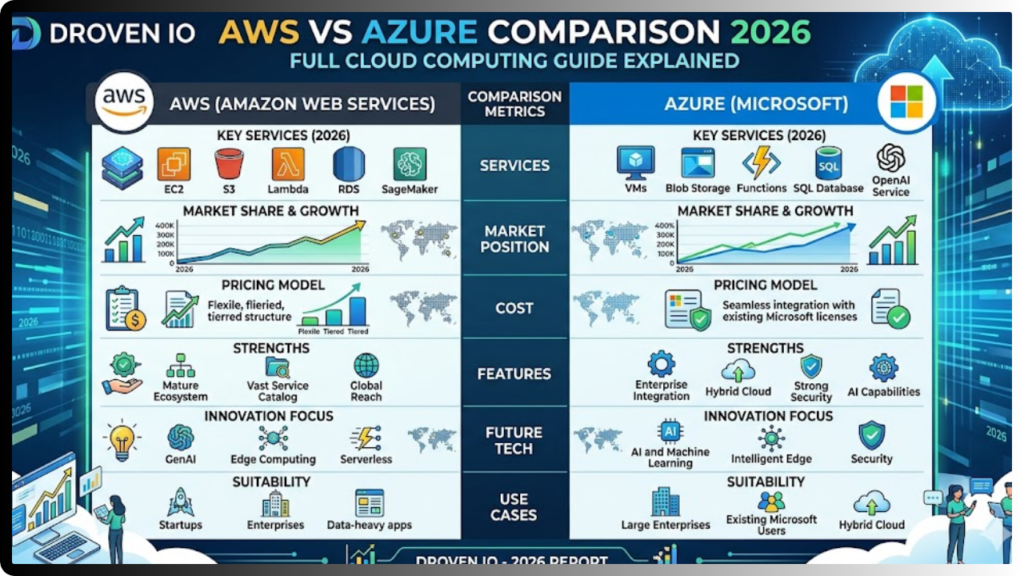

The droven io aws vs azure comparison is an important topic in cloud computing because businesses depend heavily on cloud platforms for storage, computing, and scalable infrastructure. AWS and Azure are the two leading cloud providers offering powerful services across industries. The droven io aws vs azure comparison helps developers, IT professionals, and businesses understand which platform fits their needs best. With cloud adoption increasing globally, selecting the right provider is now a strategic decision. This article breaks down their differences in a clear and structured way. Cloud technology continues to evolve rapidly making comparisons more important than ever. Organizations now rely on cloud systems for mission critical operations and data security. The demand for scalable infrastructure is growing every year across all industries. Traditional servers are being replaced by cloud based systems. Companies want better performance and lower operational costs. Cloud platforms also improve flexibility and global accessibility. Understanding both AWS and Azure helps in making smarter technology decisions. Cloud adoption is also driven by digital transformation initiatives worldwide. Businesses are shifting toward automation and AI-powered systems. The need for secure and scalable cloud infrastructure is increasing rapidly.
Who is this comparison for?
The droven io aws vs azure comparison is designed for developers, IT professionals, students, and businesses who want to understand cloud computing platforms in a practical way. It is especially useful for organizations planning cloud migration or building scalable applications. Beginners can also benefit from this comparison because it simplifies complex cloud concepts into easy explanations. The droven io aws vs azure comparison is also valuable for enterprise decision-makers evaluating cost, performance, and long-term scalability. It helps users choose the right platform based on real-world needs rather than assumptions. Startups use it to understand cloud infrastructure from the beginning. IT teams use it for designing deployment strategies. Students gain knowledge of cloud architecture fundamentals. Businesses use it to reduce infrastructure risks. It also supports digital transformation planning. Decision makers use it for budgeting cloud expenses. Overall it is useful for both technical and non technical users. Cloud learning demand is increasing in universities and training programs. Many professionals are switching careers into cloud computing.
AWS vs Azure Market Position
Global adoption in Droven IO AWS vs Azure comparison
The droven io aws vs azure comparison shows AWS leading the global cloud market, while Azure continues to grow rapidly in enterprise environments. AWS dominates startups and tech companies due to its wide service ecosystem. Azure is widely used in large enterprises because of its strong integration with Microsoft tools. The droven io aws vs azure comparison highlights that both platforms are competing closely in AI, analytics, and cloud innovation. Their market positions reflect different customer priorities and business strategies. AWS has stronger global infrastructure reach and early market leadership. Azure is expanding quickly in corporate and government sectors. Both platforms invest heavily in innovation and AI technologies. Competition between them drives faster cloud advancement. Pricing models also influence adoption rates. Customer trust plays a key role in selection. Cloud demand continues to increase worldwide. Cloud competition is pushing better services for users. Innovation cycles are becoming faster every year.
AWS vs Azure Performance Comparison
Scalability and speed in Droven IO AWS vs Azure comparison
The droven io aws vs azure comparison highlights that AWS offers highly scalable global infrastructure with strong performance and flexibility. It provides extensive availability zones that support large-scale applications. Azure focuses more on hybrid cloud performance, making it ideal for businesses combining on-premises and cloud systems. The droven io aws vs azure comparison shows AWS is preferred for complex distributed systems, while Azure excels in enterprise integration. Both platforms deliver high reliability and uptime. AWS provides low latency across global regions. Azure offers strong connectivity with enterprise systems. Both platforms support heavy workloads efficiently. Monitoring tools improve performance optimization. Scalability remains a core strength for both providers. Developers can deploy applications globally. System stability is maintained under high traffic. Performance optimization tools help reduce delays. Cloud architectures are designed for speed and efficiency. Global distribution improves user experience.
AWS vs Azure Pricing Model
Cost structure in Droven IO AWS vs Azure comparison
The droven io aws vs azure comparison shows AWS uses a detailed pay-as-you-go pricing model based on resource usage. This offers flexibility but can be complex for beginners. Azure also uses pay-as-you-go pricing but provides cost advantages for Microsoft enterprise users. The droven io aws vs azure comparison shows Azure is often more cost-efficient for organizations already using Microsoft services. Pricing depends on workload, scale, and usage patterns. AWS pricing is highly detailed and usage based. Azure offers enterprise discounts and bundled pricing options. Both platforms provide cost management tools. Budget planning is important for cloud optimization. Unexpected costs can appear without monitoring. Organizations must track resource usage carefully. Long term planning improves cost efficiency. Cloud cost optimization is becoming a priority for businesses. Financial planning tools help reduce unnecessary spending. Companies focus on reducing cloud waste.
AWS vs Azure Security Features
Compliance and protection in Droven IO AWS vs Azure comparison
The droven io aws vs azure comparison shows both AWS and Azure provide strong security and global compliance standards. AWS offers deep security customization with granular access control. Azure integrates security with Microsoft identity services for easier enterprise management. The droven io aws vs azure comparison highlights that both platforms are trusted for secure cloud environments. Security effectiveness depends on proper configuration. Both platforms support encryption at rest and in transit. Identity management systems are highly advanced. Security monitoring is available in real time. Compliance certifications meet global standards. Threat detection tools are continuously updated. Data protection remains a top priority. Organizations can customize security rules easily. Cybersecurity threats are increasing globally. Cloud providers are investing heavily in advanced protection systems. Security automation is becoming more common.
AWS vs Azure AI and Innovation
Cloud intelligence in Droven IO AWS vs Azure comparison
The droven io aws vs azure comparison shows both platforms are heavily investing in AI and machine learning technologies. AWS provides advanced tools for data processing and predictive analytics. Azure integrates AI into enterprise workflows and Microsoft productivity tools. The droven io aws vs azure comparison highlights Azure’s strong advantage in enterprise AI adoption. Both platforms continue expanding rapidly in intelligent cloud services. AI is becoming central to cloud development. Machine learning tools support automation. Data analysis capabilities are improving quickly. Businesses benefit from smart insights. Cloud automation reduces manual effort. Innovation is accelerating across both platforms. Future systems will depend heavily on AI. AI is transforming decision-making processes. Organizations are using predictive models widely. Generative AI is reshaping cloud services.
AWS vs Azure Use Cases
Real-world applications in Droven IO AWS vs Azure comparison
The droven io aws vs azure comparison shows AWS is widely used for startups, mobile apps, and large-scale web applications. Azure is commonly used in banking, government, and enterprise IT systems. AWS is ideal for developers needing flexibility and customization. The droven io aws vs azure comparison highlights Azure’s strength in hybrid cloud and corporate environments. Both platforms serve different industry needs effectively. AWS supports gaming and streaming platforms. Azure supports enterprise data systems. Both handle global workloads efficiently. Industry adoption varies by requirement. Cloud native applications are increasing rapidly. Hybrid cloud adoption is growing. Businesses choose based on workload type. Digital transformation projects rely heavily on cloud platforms. Enterprises use cloud for global expansion strategies.
AWS vs Azure Final Evaluation
Overall conclusion in Droven IO AWS vs Azure comparison
The droven io aws vs azure comparison shows that both platforms are powerful but serve different purposes. AWS focuses on flexibility, scalability, and developer control. Azure focuses on enterprise integration and hybrid cloud solutions. The droven io aws vs azure comparison proves that the best choice depends on business goals and technical requirements. There is no universal winner only the right fit for each use case. Both platforms are global leaders in cloud computing. Competition drives constant innovation. Cloud usage is increasing worldwide. Businesses benefit from both ecosystems. Technology continues evolving rapidly. Decision making depends on strategy. Both AWS and Azure remain essential. Cloud adoption is becoming a core business requirement. Future digital systems will depend heavily on cloud infrastructure. Multi-cloud strategies are becoming more common. Businesses are combining both platforms for flexibility. Cloud ecosystems are expanding rapidly.
Cloud Market Growth Trends
The global cloud market is expanding rapidly due to increasing digital transformation. Businesses are shifting from physical servers to cloud-based infrastructure for better efficiency. The droven io aws vs azure comparison highlights how both platforms are benefiting from this growth. Demand for AI, big data, and automation is driving cloud adoption worldwide. Cloud services are becoming essential for modern business operations. Companies are investing heavily in scalable infrastructure. Remote work trends are also increasing cloud dependency. Startups are rapidly adopting cloud-first strategies. Enterprises are modernizing legacy systems for better performance. Governments are also moving toward digital cloud solutions. Global competition is pushing innovation in cloud technologies. Cloud spending is increasing across industries. Data-driven decision-making is becoming standard. Cloud providers are expanding global data centers. Emerging markets are rapidly adopting cloud services.
Enterprise Cloud Transformation
Large enterprises are modernizing their IT systems using cloud platforms. The droven io aws vs azure comparison shows Azure is often preferred in enterprise transformation due to Microsoft integration. AWS is widely used for scalable application architecture. Both platforms help businesses reduce operational costs and improve performance. Cloud transformation improves business agility and speed. Organizations are replacing outdated systems with modern cloud solutions. Security improvements are a key driver of adoption. Automation is reducing manual IT workloads. Enterprises are focusing on digital-first strategies. Cloud migration is becoming a long-term priority. Hybrid environments are also increasing in demand. Enterprises are investing heavily in cloud modernization. Legacy systems are being replaced with cloud-native solutions. IT infrastructure is becoming more flexible. Digital transformation is accelerating globally.
Developer Ecosystem Comparison
Developers play a key role in cloud adoption. AWS offers a highly flexible developer ecosystem with extensive tools. Azure provides a more integrated environment with Microsoft development tools. The droven io aws vs azure comparison shows both platforms strongly support modern development practices. Developers benefit from APIs, SDKs, and automation tools. AWS provides more customization options for advanced users. Azure simplifies workflows through integrated services. Continuous deployment is easier on both platforms. DevOps adoption is increasing globally. Cloud-native development is becoming standard practice. Developers are focusing on scalability and performance. Innovation in development tools continues to grow. Cloud SDKs improve productivity. Automation tools speed up deployment. Collaboration between teams is improving.
Hybrid Cloud Capabilities
Hybrid cloud is becoming a major requirement for businesses. Azure leads in hybrid cloud solutions with strong on-premises integration. AWS also offers hybrid tools but focuses more on cloud-native systems. The droven io aws vs azure comparison shows hybrid capability is a key deciding factor for enterprises. Hybrid cloud enables smooth transition between local and cloud systems. Businesses use hybrid models for flexibility and control. Data security is improved through hybrid setups. Cost optimization is another major benefit. Enterprises are avoiding full migration risks. Hybrid adoption is increasing across industries. IT teams prefer flexible infrastructure models. Hybrid systems support disaster recovery. Multi-cloud strategies often include hybrid setups. Organizations are balancing workloads efficiently.
Data Storage Solutions
Both AWS and Azure provide advanced data storage services. AWS offers scalable object and block storage systems. Azure provides integrated storage solutions for enterprise applications. The droven io aws vs azure comparison shows both platforms support secure and high-performance data storage. Storage systems are designed for scalability and durability. Data backup and recovery options are highly reliable. Both platforms support global data replication. Storage security is maintained through encryption. Businesses rely heavily on cloud storage systems. Data accessibility is improved across regions. Storage optimization helps reduce operational costs. Storage performance is continuously improving. Data lifecycle management is automated. Large datasets are handled efficiently. Cloud storage is essential for AI workloads.
Networking and Connectivity
Networking is essential for cloud performance. AWS provides highly configurable networking options. Azure focuses on enterprise-grade connectivity solutions. The droven io aws vs azure comparison shows both platforms ensure low latency and secure communication between services. Networking tools support global connectivity. Load balancing improves application performance. Virtual networks enhance system isolation. Security layers protect data transmission. Cloud networking enables faster application delivery. Hybrid connectivity is also supported. Enterprises rely on stable network architecture. Network optimization improves performance. Global distribution enhances speed. Secure communication channels are widely used. Networking automation improves efficiency.
Reliability and Uptime
Cloud reliability is a key factor for businesses. AWS and Azure both offer high uptime guarantees. AWS provides multiple availability zones globally. Azure ensures strong redundancy and backup systems. The droven io aws vs azure comparison confirms both platforms are highly reliable. System failures are minimized through redundancy. Disaster recovery solutions are built-in. Monitoring systems detect issues in real time. Businesses require uninterrupted service availability. Global infrastructure improves uptime performance. Reliability builds customer trust. Cloud stability is essential for mission-critical systems. Failover systems ensure continuity. High availability zones increase resilience. Monitoring tools improve stability.
Artificial Intelligence Expansion
AI is a major growth area in cloud computing. AWS and Azure both offer powerful AI services. Azure integrates deeply with enterprise AI tools. AWS provides advanced machine learning capabilities. The droven io aws vs azure comparison shows both are competing strongly in AI innovation. AI is transforming business automation. Machine learning improves data accuracy. Predictive analytics supports decision-making. Enterprises are adopting AI at scale. Cloud AI tools are becoming more advanced. Innovation in AI is accelerating rapidly. Future systems will rely heavily on intelligent automation. AI improves efficiency across industries. Businesses are integrating AI into workflows. Automation reduces operational costs.
Future of Cloud Computing
The future of cloud computing is expected to be driven by AI, automation, and edge computing. AWS and Azure will continue to expand their services. The droven io aws vs azure comparison shows both platforms will remain leaders in global cloud innovation. Edge computing will reduce latency significantly. Automation will improve operational efficiency. AI integration will increase across industries. Cloud adoption will continue to grow globally. Security will become more advanced and adaptive. Hybrid and multi-cloud strategies will expand further. Businesses will depend more on cloud ecosystems. Continuous innovation will shape the next decade of technology. Quantum computing may reshape cloud architecture. Serverless computing will become standard. Cloud-native systems will dominate IT infrastructure. Sustainability will become a major focus area.
FAQs
What is the main difference between AWS and Azure?
AWS focuses on flexibility and scalability while Azure focuses on enterprise integration and hybrid cloud systems.
Which cloud platform is more popular?
AWS currently leads in global market share while Azure is growing rapidly in enterprises.
Is AWS cheaper than Azure?
Pricing depends on usage but Azure can be cheaper for Microsoft-based organizations.
Which is better for beginners?
Azure is generally easier for beginners due to its simple interface.
Can AWS and Azure be used together?
Yes many companies use both in multi-cloud environments.
Final Thought
The droven io aws vs azure comparison clearly shows that both AWS and Azure are powerful cloud platforms with unique strengths. AWS is ideal for developers, startups, and highly scalable applications, while Azure is better suited for enterprise environments and hybrid cloud systems. The droven io aws vs azure comparison proves that the right choice depends on business goals, technical needs, and existing infrastructure. Both platforms continue to evolve rapidly with advancements in AI, security, and global cloud services. Instead of choosing a single winner, businesses benefit most by selecting the platform that aligns with their long-term digital strategy. Cloud adoption is now a core part of modern business transformation. Organizations are increasingly moving toward multi-cloud strategies for better flexibility. Future innovations in cloud computing will further reduce the gap between AWS and Azure. Continuous updates from both providers ensure long-term reliability and performance.