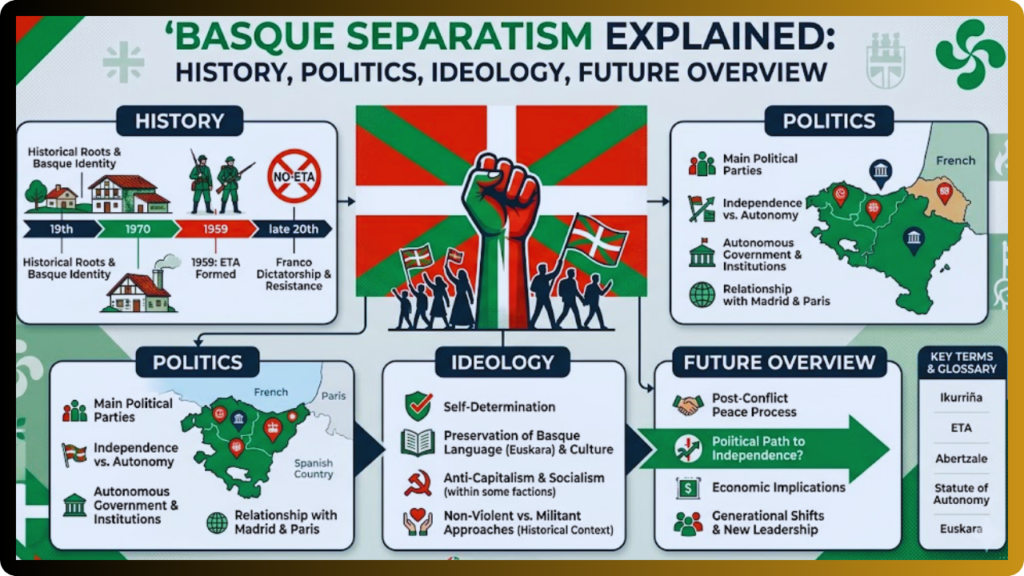

Basqueserpartists are associated with a long-standing political and cultural movement in the Basque region that seeks greater autonomy or full independence. The Basque Country is known for its strong cultural identity, shaped by its unique language, traditions, and historical background. Over time, basqueserpartists have become an important part of discussions about regional nationalism in Europe. The movement has changed significantly from its early resistance-focused origins into a more political and democratic form. Today, basqueserpartists continue to influence debates about identity, governance, and self-determination. The movement is often studied as an example of regional nationalism in modern Europe. It also reflects how cultural identity can shape political demands over time. It remains a key topic in European political studies and regional governance discussions. The Basque identity continues to play a strong role in shaping political awareness. Many scholars analyze basqueserpartists to understand autonomy movements. Their influence extends across both historical and modern political contexts. The movement highlights the link between culture and political aspiration. It continues to evolve with changing global and regional dynamics.
Who are Basqueserpartists?
Basqueserpartists are individuals and groups who support either full independence or expanded autonomy for the Basque region, which is located in northern Spain and southwestern France. They believe the Basque people have a distinct national identity that deserves political recognition. This identity is strongly connected to the Basque language and cultural traditions that differ from surrounding regions. Basqueserpartists are not a single organization but a broad ideological movement with different viewpoints. Their goals range from complete independence to greater regional self-government. They also emphasize the importance of preserving cultural heritage in modern society. Their political beliefs are shaped by both history and cultural pride. Many supporters are also active in democratic political processes. The movement includes both moderate and strong nationalist perspectives. It continues to influence regional discussions on governance. Cultural identity remains the core foundation of their ideology. Their presence is visible in both politics and society.
Historical Background of Basqueserpartists
Evolution of Basque political identity
The history of basqueserpartists is deeply connected to political tensions in Spain during the 20th century. Under authoritarian rule, Basque cultural expression and language were restricted, leading to resistance movements. These conditions encouraged the rise of organized groups advocating for identity and autonomy. One of the most historically known organizations connected to this movement was ETA, which played a major role in shaping global awareness of Basque separatism. Over time, basqueserpartists shifted from conflict-based resistance to political participation. This transition helped reshape their global image and political strategy. It also encouraged more democratic forms of activism. The movement gradually moved toward peaceful political engagement. Historical struggles influenced modern Basque nationalism. Cultural suppression played a major role in shaping resistance. Political reforms later allowed greater expression. This evolution continues to define their identity today.
Ideology and Goals of Basqueserpartists
Cultural preservation and self-determination
The ideology of basqueserpartists is based on the belief that the Basque people form a distinct nation with their own cultural and linguistic identity. The preservation of the Euskara language is a central element of this ideology. Many basqueserpartists argue that political autonomy is necessary to protect their culture and manage local affairs effectively. Economic strength in the Basque region also supports arguments for increased independence. In modern times, most basqueserpartists promote peaceful and democratic approaches. Their ideology continues to evolve with changing political conditions. Cultural survival is a key motivation for their movement. Education plays an important role in spreading identity awareness. Political participation is now a major strategy. Many groups focus on negotiation rather than conflict. Identity and governance remain deeply connected. Their goals reflect both tradition and modern political needs.
Modern Role of Basqueserpartists
Political participation and regional governance
Today, basqueserpartists are mainly active through political parties and civic organizations operating within democratic systems. They participate in elections and influence regional policy decisions in the Basque Country. The movement has largely moved away from violent methods and now focuses on legal and political processes. Many basqueserpartists emphasize cultural education, language preservation, and economic development. Their presence remains strong in regional governance structures. They also contribute to shaping public debates on autonomy and identity. Their political influence is visible in local institutions. Cooperation with national systems has increased over time. Democratic engagement is now the main strategy. Public representation is an important achievement. Policy-making reflects their regional priorities. They continue to shape political dialogue in Spain. Their role in policymaking continues to expand gradually. Youth participation in politics is also increasing. Digital platforms are helping strengthen their outreach and communication.
Basqueserpartists in European Politics
Influence on regional autonomy debates
Basqueserpartists have also influenced broader European discussions on regional autonomy and minority rights. Their movement is often referenced in debates about how large countries can manage diverse cultural identities. Some European regions view the Basque model as an example of strong decentralization. Basqueserpartists continue to advocate for greater political recognition within larger national frameworks. This influence extends beyond Spain into wider European political thought. It also highlights the importance of cultural diversity in governance systems. Their example is studied in political science. Regional autonomy debates often reference their history. European institutions monitor such movements closely. Cultural rights remain a key discussion point. Their impact is both regional and international. They contribute to ongoing political discourse in Europe. Their ideas have inspired similar regional movements across Europe. Academic research frequently analyzes their political structure. Cross-border cooperation has also increased awareness of their goals.
Public Perception of Basqueserpartists
Changing views over time
Public perception of basqueserpartists has evolved significantly over the decades. In earlier periods, the movement was often associated with political conflict and instability. However, with the decline of violent activity, perceptions have become more balanced and political. Many people now see basqueserpartists as representatives of cultural identity rather than conflict. Despite this, opinions still vary depending on political and historical perspectives. Media coverage has also played a major role in shaping these changing views. Public trust has gradually improved over time. Education has helped reduce misunderstandings. Political dialogue has softened earlier tensions. Generational differences affect opinions. Modern narratives focus more on culture. The image of the movement continues to evolve. Social media has also influenced public awareness. Younger generations tend to view the movement more positively. Historical interpretation still shapes older perspectives.
Challenges Faced by Basqueserpartists
Political and constitutional limitations
Basqueserpartists face several challenges in achieving their goals within the existing political system. One major challenge is the constitutional structure of Spain, which limits the possibility of full independence. Another challenge is internal division within the movement regarding long-term objectives. Economic and political negotiations also shape their progress. These challenges make the movement complex and multi-layered. External political pressures further influence their strategies and decisions. Legal restrictions affect their demands. Political disagreement exists within supporters. Economic dependency influences outcomes. Negotiations are often slow and complex. Public opinion also creates limitations. Institutional barriers remain significant obstacles. Balancing autonomy and unity is a continuing struggle. Political compromise is often necessary for progress.
Future Outlook of Basqueserpartists
The future of basqueserpartists will likely depend on political dialogue and changing public opinion. The movement is expected to continue operating through democratic channels. Cultural preservation will remain a central focus regardless of political outcomes. Some groups may push for greater autonomy, while others may continue advocating for independence. Overall, basqueserpartists will remain an important part of regional politics in the Basque Country. Their future will also be shaped by economic and social developments in Europe. Technological change may also influence political engagement. Younger generations will shape future directions. Dialogue between regions may increase. Political reforms could affect outcomes. Cultural identity will remain central. Economic globalization may influence strategies. Environmental and social issues may reshape priorities. The movement will continue adapting to modern political realities.
Basque Language and Identity Preservation
The Basque language, Euskara, is one of the oldest languages in Europe and is central to basqueserpartists’ identity. Efforts to preserve and expand its use are a key part of cultural policy in the region. Schools and institutions promote bilingual education to strengthen language survival. Cultural programs support traditional music, festivals, and literature. Language preservation is essential for maintaining identity. It is also used as a political symbol of unity and heritage. Government support helps promote its daily use. Digital learning platforms are increasing accessibility. Younger generations are showing renewed interest. Media in Euskara is expanding steadily. Cultural identity is strongly linked to language survival. Linguistic policy remains a major political topic.
Economic Strength of the Basque Region
The Basque region is one of the most economically developed areas in Spain. Industrial growth, manufacturing, and technology sectors contribute to its strong economy. Basqueserpartists often use this economic success as an argument for greater autonomy. They believe local control over taxation and spending improves efficiency. Economic independence discussions are closely linked to political goals. Strong infrastructure supports long-term stability. Innovation and research industries are expanding. Export-driven growth strengthens regional power. Employment rates are relatively high. Foreign investment supports development. Financial autonomy remains a key debate. Economic performance reinforces political confidence.
Education and Political Awareness
Education plays a key role in shaping political awareness among younger generations in the Basque region. Schools emphasize cultural history and language learning. This helps maintain a strong sense of identity among youth. Political awareness programs also encourage civic participation. Education is considered a long-term strategy for cultural preservation. Universities contribute to political research and debate. Students are encouraged to participate in cultural activities. Curriculum includes regional history and identity studies. Youth organizations promote leadership development. Exchange programs increase global awareness. Educational reforms support bilingual learning systems. This strengthens both cultural and political engagement. Digital tools are modernizing education. Critical thinking is widely encouraged. Early education strongly influences identity formation.
Media Influence on Basqueserpartists
Media coverage has played an important role in shaping public understanding of basqueserpartists. Earlier reporting often focused on conflict and political instability. Modern coverage is more balanced, highlighting cultural and political aspects. Digital media has increased awareness among younger audiences. Media narratives strongly influence public opinion. Social media spreads political ideas quickly. Independent journalism has diversified perspectives. International reporting shapes global perception. Documentaries explain historical evolution. Online debates influence political discussion. Media bias has reduced over time. Communication strategies are now more advanced. Influencers also shape opinions. Real-time news increases engagement. Media remains a powerful political tool.
Global Comparisons with Other Movements
Basqueserpartists are often compared with other regional independence movements worldwide. These comparisons help researchers understand patterns of nationalism and autonomy. Similar movements exist in Europe and beyond. However, each movement has unique cultural and historical backgrounds. The Basque case is often seen as a structured autonomy model. Scholars study it as a negotiated political system. Differences in outcomes are widely analyzed. Some movements share cultural arguments. Others differ in strategy and success. Case studies often include Basque examples. It is a key reference in political science. Comparisons highlight global diversity in nationalism. International cooperation studies often reference this movement. Political stability varies across similar movements. Historical context plays a major role in outcomes.
Role of Women in Basqueserpartists Movement
Women have played an important role in both cultural and political aspects of basqueserpartists. They participate actively in political parties, education, and cultural preservation. Their involvement has increased significantly over time. Women also contribute to leadership roles in regional governance. Gender inclusion has strengthened the movement’s social structure. Female participation in politics continues to grow. Women-led organizations support cultural projects. Education has improved equality opportunities. Leadership roles are becoming more balanced. Social reforms support inclusion. Women influence policy decisions. Their role continues to expand in modern politics. Women are increasingly visible in decision-making positions. Gender equality movements support their participation. Their contribution strengthens community development.
Technology and Modern Political Engagement
Technology has changed how basqueserpartists communicate and organize. Social media allows fast political mobilization. Digital tools increase youth participation. Online campaigns promote cultural identity. Technology reshapes political strategies. Mobile apps support language learning. Virtual communities strengthen identity networks. Data-driven campaigns improve outreach. Digital education supports awareness. Online forums encourage discussion. Cyber platforms expand visibility. AI tools are also being adopted. Technology modernizes activism. Digital security systems protect communication. Online engagement increases political awareness. Innovation continues to reshape activism methods. Digital platforms enable global outreach. Real-time communication improves coordination. Technology also supports political transparency.
Environmental Policies and Regional Identity
Environmental protection is an emerging focus in the Basque region. Basqueserpartists support sustainable development and green policies. Natural landscapes are tied to cultural identity. Environmental activism reflects regional pride. Renewable energy is widely promoted. Conservation efforts protect heritage. Green economy projects are expanding. Climate awareness is growing. Sustainability is a policy priority. Environmental education is increasing. Ecological balance is emphasized. Urban planning includes green initiatives. Renewable resources are prioritized in development plans. Community participation supports environmental projects. Long-term sustainability goals are widely encouraged. Biodiversity conservation is also prioritized. Pollution control policies are improving. Environmental innovation supports regional development.
Legal Framework and Autonomy Structure
The Basque Country has one of the highest levels of autonomy in Spain. Its legal framework allows control over taxation, education, and governance. Full independence is still restricted by national law. This structure defines basqueserpartists’ political limits. Negotiations continue within constitutional rules. Regional institutions hold significant power. Fiscal agreements support autonomy. Legal reforms shape governance. Political dialogue defines progress. Administrative systems support control. Constitutional law sets boundaries. The system balances unity and autonomy. Judicial oversight ensures legal stability. Political negotiations remain ongoing. Future reforms may further define autonomy levels. Legal interpretation plays a major role in governance. Institutional cooperation supports stability. Constitutional balance is carefully maintained.
FAQs
What are basqueserpartists?
Basqueserpartists are individuals or groups who support Basque independence or greater regional autonomy.
Where is the Basque region located?
The Basque region is located in northern Spain and southwestern France.
Do basqueserpartists use violent methods today?
No, modern basqueserpartists mainly use peaceful and democratic political methods.
What language is important to basqueserpartists?
The Basque language, known as Euskara, is central to their cultural identity.
Are basqueserpartists a single political party?
No, they represent a broad movement made up of different parties and organizations.
- You May Like this:Pixelspinx com Explained 2026 Features Purpose and Full Digital Overview
Final Thought
Basqueserpartists represent a long and evolving political identity rooted in culture, history, and regional pride. While their strategies and influence have changed over time, their focus on preserving Basque identity remains strong. Today, basqueserpartists play an important role in shaping regional politics through peaceful and democratic engagement. The movement continues to be a major example of how culture can shape political systems. Their future will depend on dialogue, cooperation, and evolving political realities. It reflects the strong connection between identity and governance. Their journey shows continuous political evolution. Peaceful methods have replaced conflict-based resistance. Cultural identity remains their strongest foundation. Political participation is steadily growing. Their influence remains significant in Europe and beyond. Cultural preservation continues to guide their vision. Global political trends may also affect their development. The movement remains a key example of modern regional nationalism.